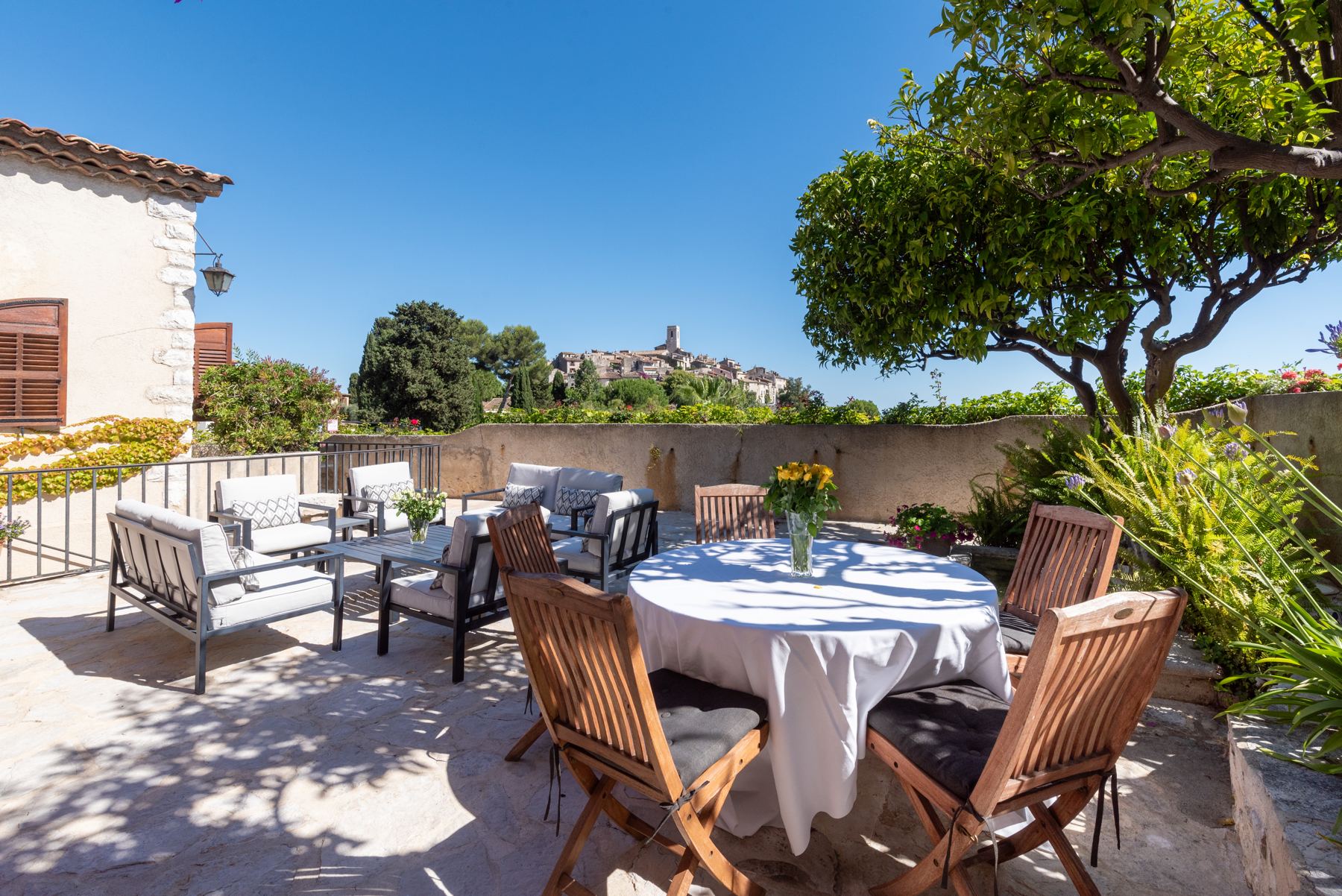
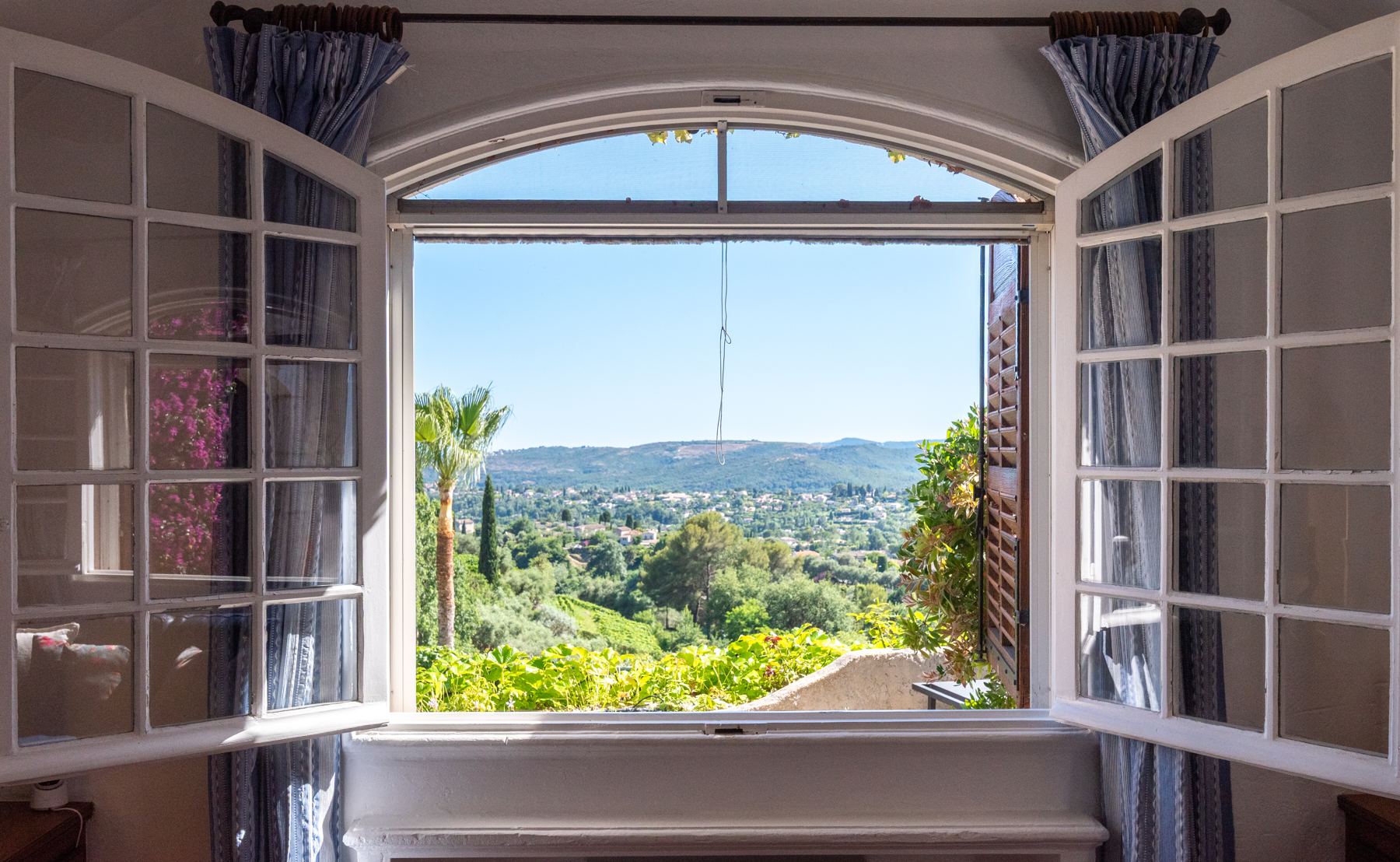
A stone house facing the village
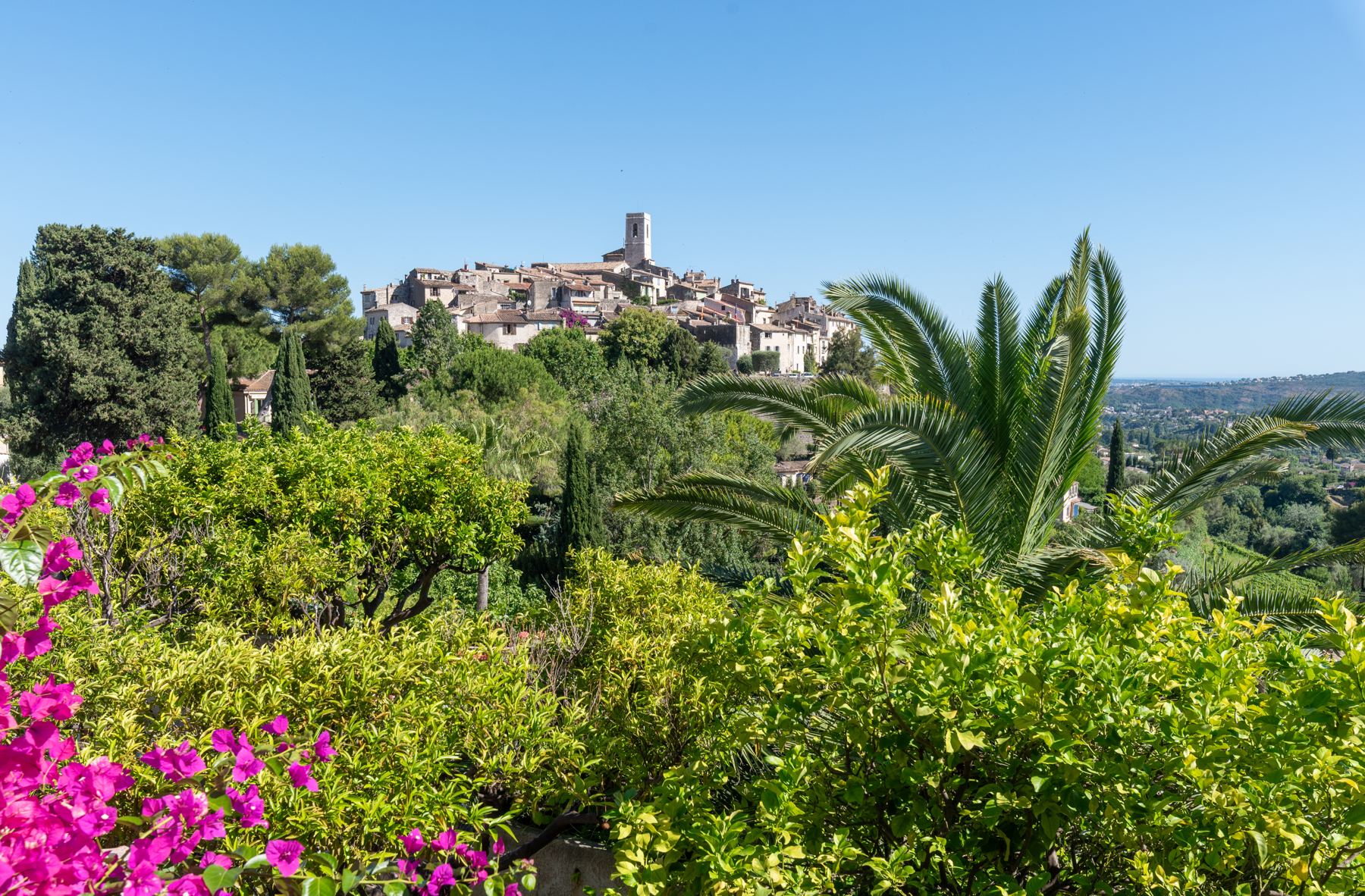
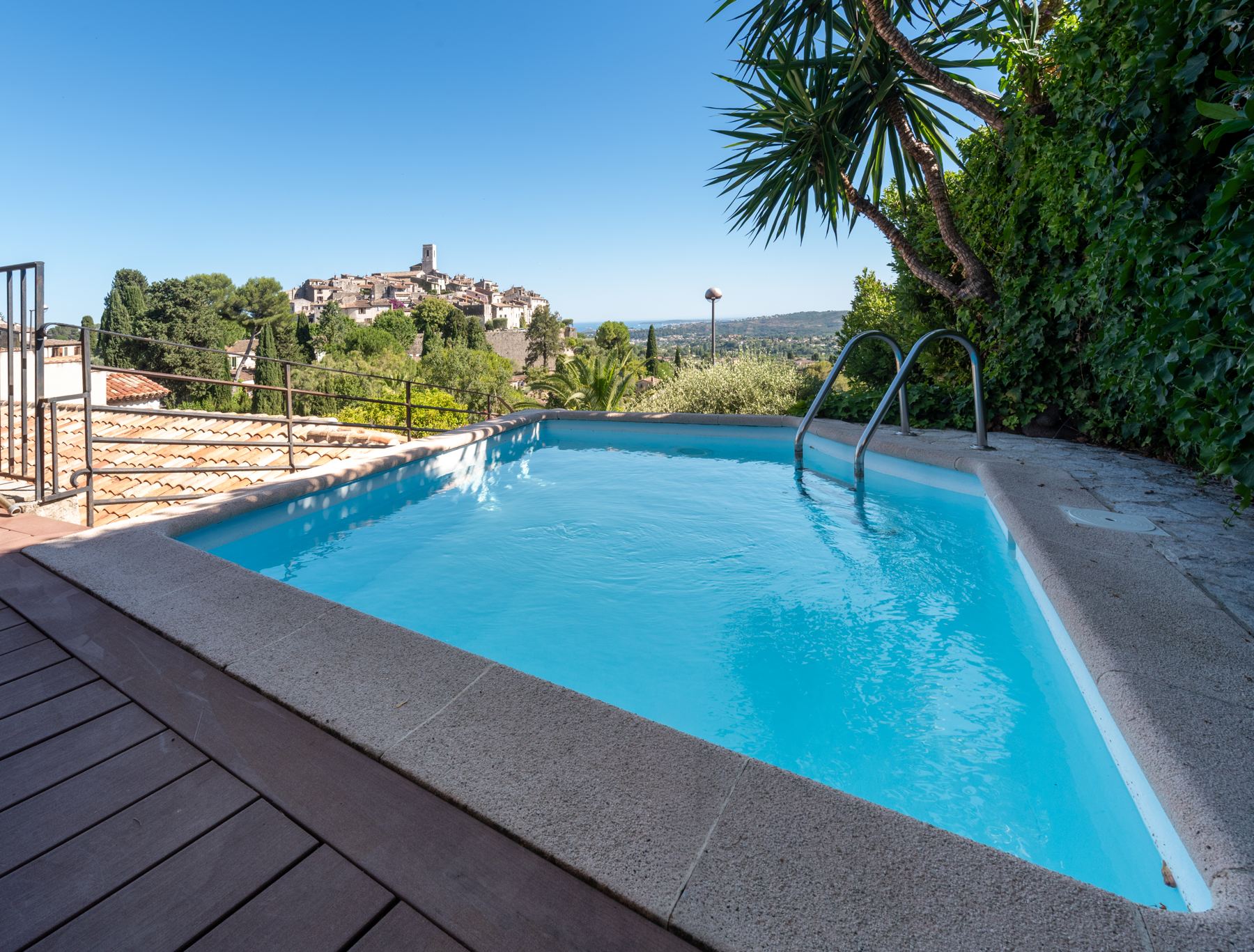
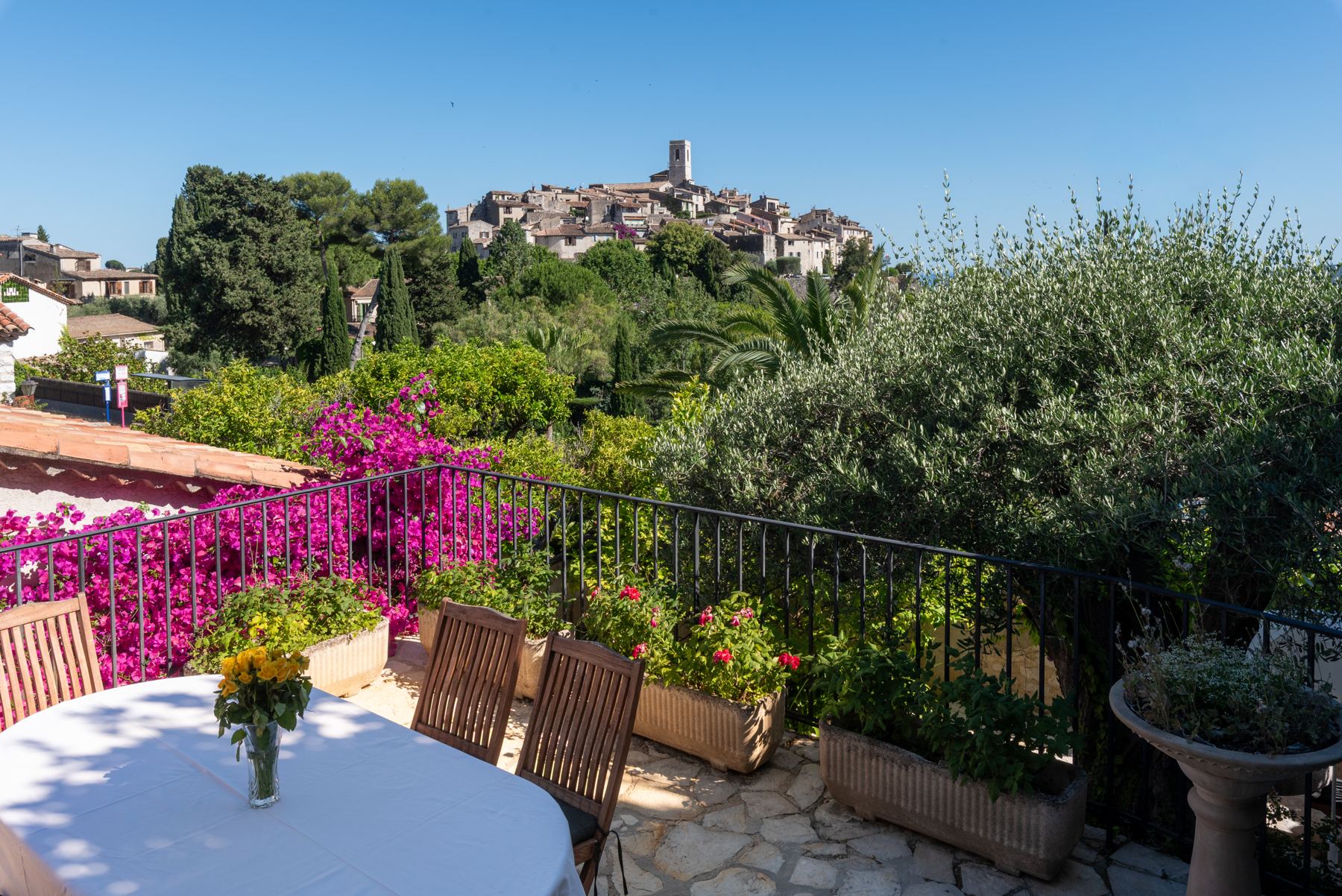
Le Mas Colombes sits just below the ramparts of Saint-Paul-de-Vence, on the old road toward La Colle-sur-Loup. From the terraces and pool, you look straight across to the village: its church tower, ramparts and rooftops rising up the hillside.
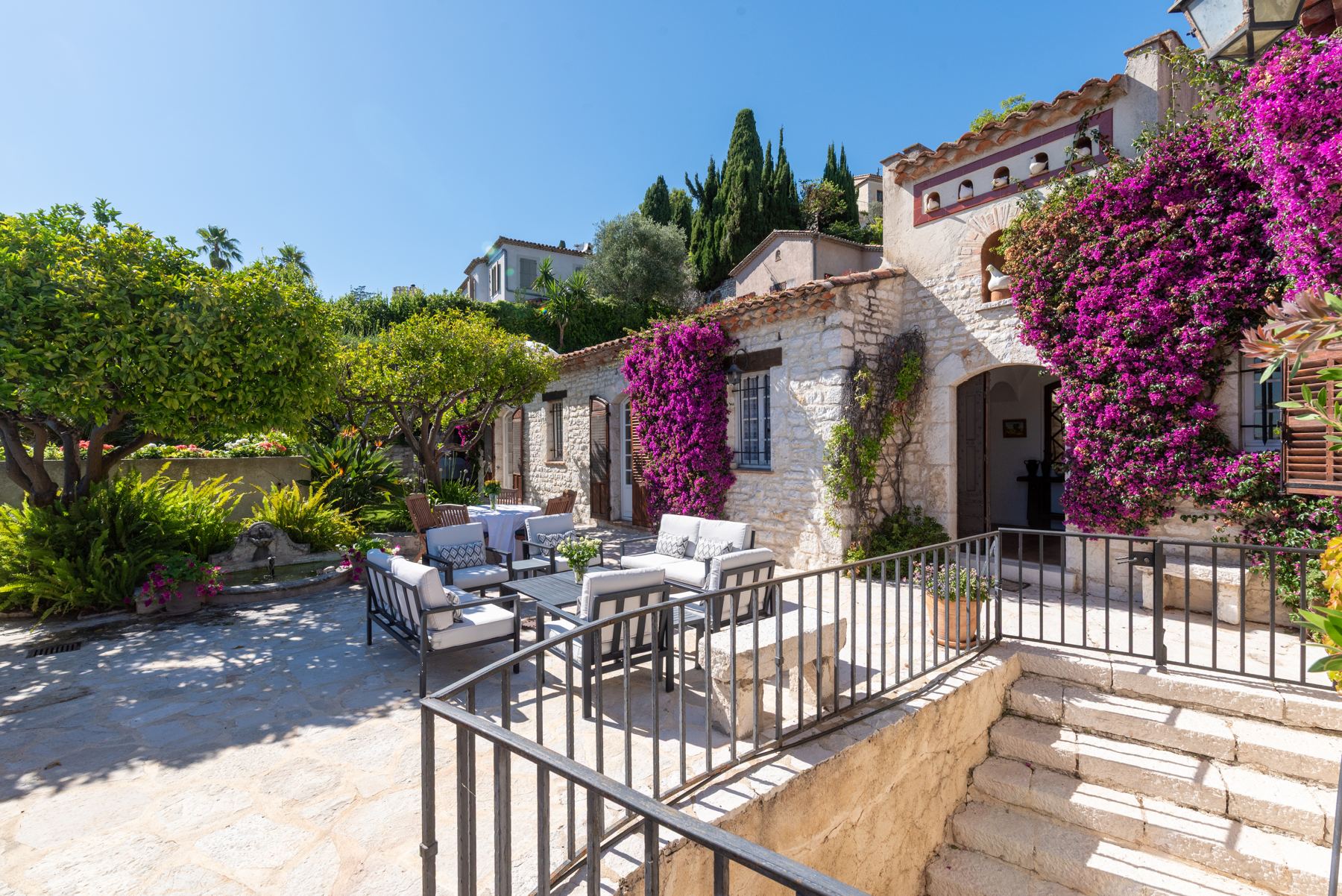
The house is built the way houses here have been built for centuries: rough stone walls, lime-washed plaster, handmade terracotta floors, old beams, arches and vaulted ceilings. Bougainvillea covers the front, and citrus and olive trees shade the terraces.
The name comes from the doves. A mosaic of two doves is set into a garden wall, and a ceramic dove sits in a brick niche beside the door.
- Location
- Saint-Paul-de-Vence
- Bedrooms
- 3, plus a children's bunk room
- Bathrooms
- 3 full bathrooms, plus a powder room
- Layout
- Two wings on one level
- Outside
- Pool, terraces, fountain garden
- Materials
- Stone, lime plaster, terracotta
The house
Stone walls, a carved front door and a paved terrace off the entrance. The top of the wall is finished with a pierced tile frieze, a detail found on old houses around the village.
Terraces and garden
The garden steps down the slope in terraces: a dining terrace under the trees, a fountain garden, a stone loggia cut into the hillside, and the pool, which faces the village.
Inside
Terracotta tomette tiles run throughout the house. The living room has a stone fireplace and windows on both sides, and arched openings lead to the dining room and entrance hall.
Bedrooms
Three bedrooms and a small children's bunk room, with three full bathrooms and a powder room. All the main rooms open through French doors onto a terrace or the garden.
Floor plan
The two wings meet at the entrance. The living wing holds the living room, dining room, kitchen and one bedroom suite. The bedroom wing holds the other two bedrooms, the bunk room, the laundry and the dressing room.
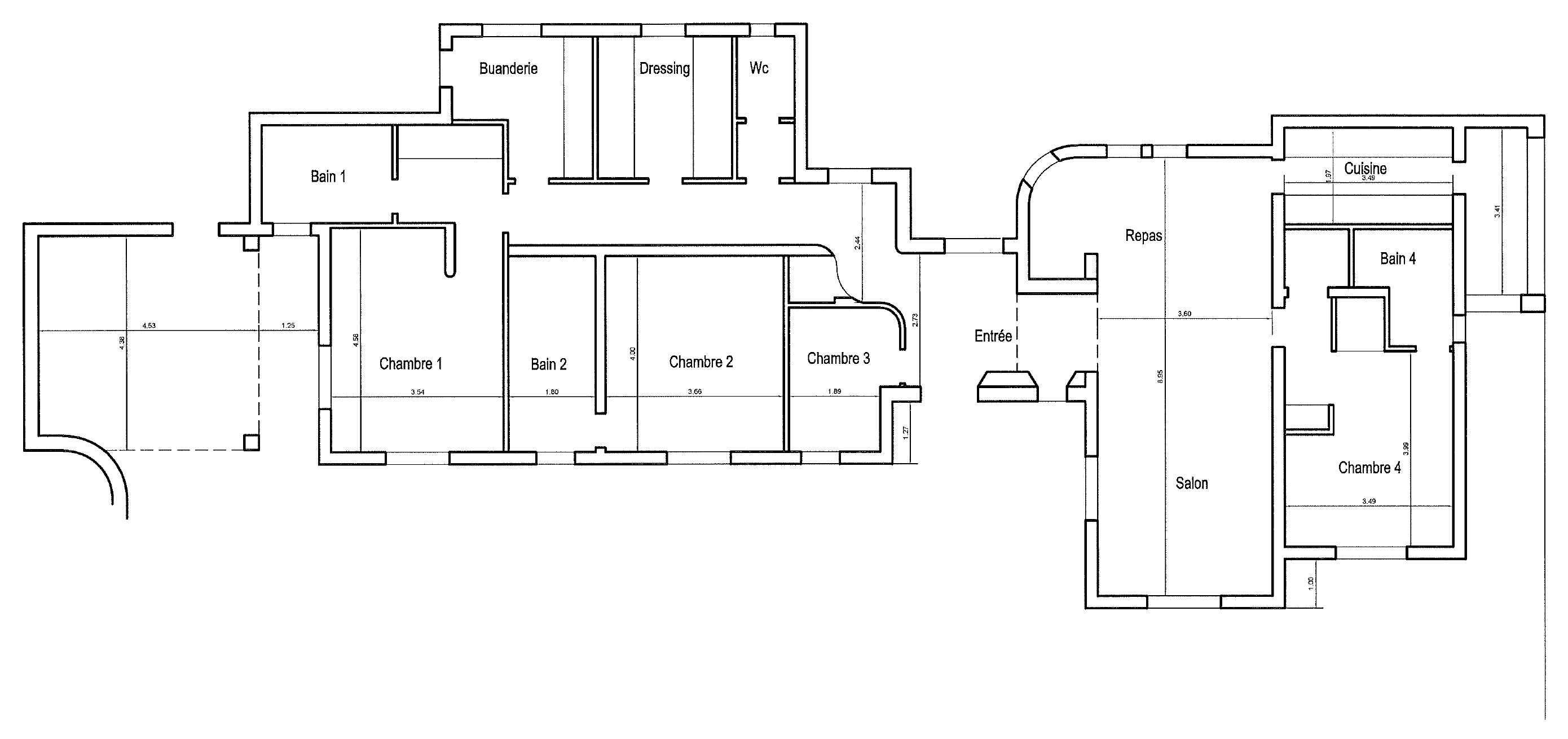
Living wing
Living room, dining room, kitchen and one bedroom with its own bathroom
Bedroom wing
Two bedrooms, the bunk room (Chambre 3 on the plan), two bathrooms, laundry, dressing room and powder room
Outside
Pool and garden terraces on several levels
The mayor's house
The living wing is the oldest part of the house. It's believed to be more than a century old and still has its old doors and beams. For many years, the house belonged to Marius Issert, mayor of Saint-Paul from 1945 to 1995. He's the mayor who got the village ramparts protected as a historic monument.
- 1950Marius Issert, his brother Gaston and his sister Noélie, both hoteliers in the village, buy the property in the Sainte-Claire quarter. The bedroom wing dates from the Issert years.
- 1961The family property is divided, and the house goes to Marius.
- 1975Marius and his wife, Paulette, sell the house. By the early 1980s, it's known as the Mas Sainte Claire.
- 1985The Zimmerman family buys the house and later adds the pool.
A village of painters
Saint-Paul has stood on its hill since the Middle Ages. For the past century, it has been one of Europe's great art villages.
For centuries, it was a border fortress. In 1538, King François I passed through and ordered the bastioned ramparts that still encircle the village, to defend the border with Savoy across the Var River. They're intact today, and you can walk the entire circuit.
Then, in the 1920s, the painters arrived. Signac, Dufy and Soutine came first, drawn by the light. From 1911 to 1932, a tram from Cagnes stopped near the house; the street behind it is still called Rue Derrière la Gare du Tram.
In 1920, Paul Roux opened a café called Chez Robinson just outside the village gate. It later became La Colombe d'Or. Artists short on money paid for meals and rooms with their paintings. Others followed, leaving works of their own.
After the war, it was the place to be. Jacques Prévert lived here. Yves Montand and Simone Signoret met at La Colombe d'Or in 1949 and married in the village in 1951. Marius Issert, the mayor who owned this house, performed the ceremony, with Prévert and Paul Roux as witnesses.
Marc Chagall lived in Saint-Paul from 1966 until his death in 1985 and is buried in the village cemetery. James Baldwin lived here for 17 years, until his death in 1987. In 1964, Aimé and Marguerite Maeght opened the Fondation Maeght on the hill above the village, in a building designed by Josep Lluís Sert.
Picasso · Matisse · Chagall · Miró · Braque · Léger · Calder · Giacometti · Signac · Dufy · Soutine
Café de la Place and the old village
Right at the village gate, near La Colombe d'Or, the Café de la Place looks out over the boules ground under the plane trees. Yves Montand and Lino Ventura played here, and inside the café is a César sculpture that players must kiss if they lose without scoring a point. Order a pastis and watch a game, then walk up the Rue Grande into the old village.
Village photos from Wikimedia Commons: Berthold Werner, JIP, MOSSOT, Darkhimmel, BrokenSphere, Abxbay. Licensed CC BY-SA 3.0 / 4.0.


La Colombe d'Or
Since 1920, at the village gate. A few minutes' walk up from the house.
It's the reason many people come to Saint-Paul. It's still run by the Roux family, and the walls are the collection: works by Picasso, Matisse, Miró, Braque and Chagall inside, a Léger on the terrace and a Calder mobile by the pool. Some of it was traded for meals and rooms.
Have lunch on the terrace and order the hors d'oeuvres, a spread of small plates that keeps coming. Or stop in for a drink at the bar after the Fondation Maeght. Book ahead, especially in summer.
If you're staying at the house
Our short list. Saint-Paul alone is worth a full day.
Walk from the house
- Fondation Maeght, then La Colombe d'Or. Tour the Maeght, walk back down, then have drinks at the bar and dinner at the Colombe. If you only do one thing, do this.
- Café de la Place. A pastis at the village gate while you watch the boules games.
- Le Tilleul. A great local restaurant with a panoramic terrace in the shade of an old linden tree.
- Les Remparts. Another great local spot, on the Rue Grande, with a panoramic view from the terrace.
- Walk the ramparts at the end of the day, and stop at Chagall's grave in the village cemetery.
A short drive
- Boucherie Beltrando, La Colle-sur-Loup. The best steaks around; get the dry-aged Parthenaise côte de bœuf. About five minutes down the road from the house.
- Auberge des Seigneurs, Vence. Super old-school, casual and fun. Run by the third generation of the family, who are dear friends of ours. You choose beef, lamb or chicken, and it's all excellent.
- Le Clemenceau, Vence old town. Casual, with great food.
The coast
- Restaurant César, La Garoupe beach, Cap d'Antibes. Lunch in the sand and a day at the beach. Great for kids.
- Hôtel du Cap-Eden-Roc, Antibes. Lunch and a day by the pool. Super fancy and iconic.
- Old town Antibes. Worth a wander through the old streets.
- Maison Lerda, Cannes. Butchers since 1953, with a meat bar facing the Forville market. Pick your cut at the counter and they cook it. Go for lunch after the market (closed Mondays).
- Cours Saleya antiques market, Nice. Mondays in old Nice. Not fancy at all, but very Niçois.
- La Petite Maison or La Merenda, Nice. Both for dinner. La Merenda is small and classic.
- La Chèvre d'Or, Èze. Drinks on the cliff, then dinner at La Chaumière.
- Le 55, Saint-Tropez. Lunch on the beach. Go by boat if you can.
On the map
Everything on our list, with the house in the middle. Search or tap a place to find it; each one links to Google Maps for directions.
Getting here
Saint-Paul-de-Vence is a walled hilltop village between Nice and Grasse, known for its painters and for the Fondation Maeght just up the hill. The house sits below the ramparts, a short walk from the village gate.
The coast is 15 to 20 minutes' drive down the hill, and the foothills of the Alps begin just behind. Times below are approximate driving times without traffic; summer traffic can add a lot.
- Saint-Paul-de-Vence villagea short walk
- Venceabout 10 min
- Nice Côte d'Azur Airportabout 25–30 min
- Antibesabout 25 min
- Niceabout 30 min
- Cannesabout 35 min
- Monacoabout 45 min
- Saint-Tropezabout 1 hr 45 min